Developing new skills as a school community: How can Teacher Librarians read + lead?
When considering how a teacher librarian might best share with and respond to the needs of their staff, I looked at skills development through three lenses:
1. Goalsetting as a community
2. Community involvement and leadership
3. Student participation in the SLLC community
I'm noticing a repetitive vocab trend here..."community" much? Clearly that's an important aspect in my views of TL leadership!
1. Goalsetting and “laying the groundwork”:
Cool resource idea: https://www.digitalhumanlibrary.com/
I think this is such an innovative and interesting resource to share with teaching staff, and as a way to help them build their own personal learning networks within their specific subject areas. It could help teachers respond to their curricular needs in an authentic and meaningful way.

"Digital
Human Library brings people together to make a difference for kids. We create
opportunities for K-12 students to learn with Canada’s largest network of
industry professionals by connecting classes with subject matter Experts for thousands of
interactive 1:1 video conferences supported by over 1500 educational virtual
tours, and live Indigenous Learning Programs guided by authentic Indigenous
content. Our community of Experts and
virtual content are sourced by Canadian teachers for Canadian teachers to
support youth and learning across Canada." [excerpt and image from www.digitalhumanlibrary.com]
2. Community involvement and leadership:
As a newly-appointed TL, I would also like to ensure I am taking on some leadership roles within my school community. I like this graphic by the Future Ready Librarians Framework, which “helps define ways librarians can lead, teach, and support in their schools and systems.”
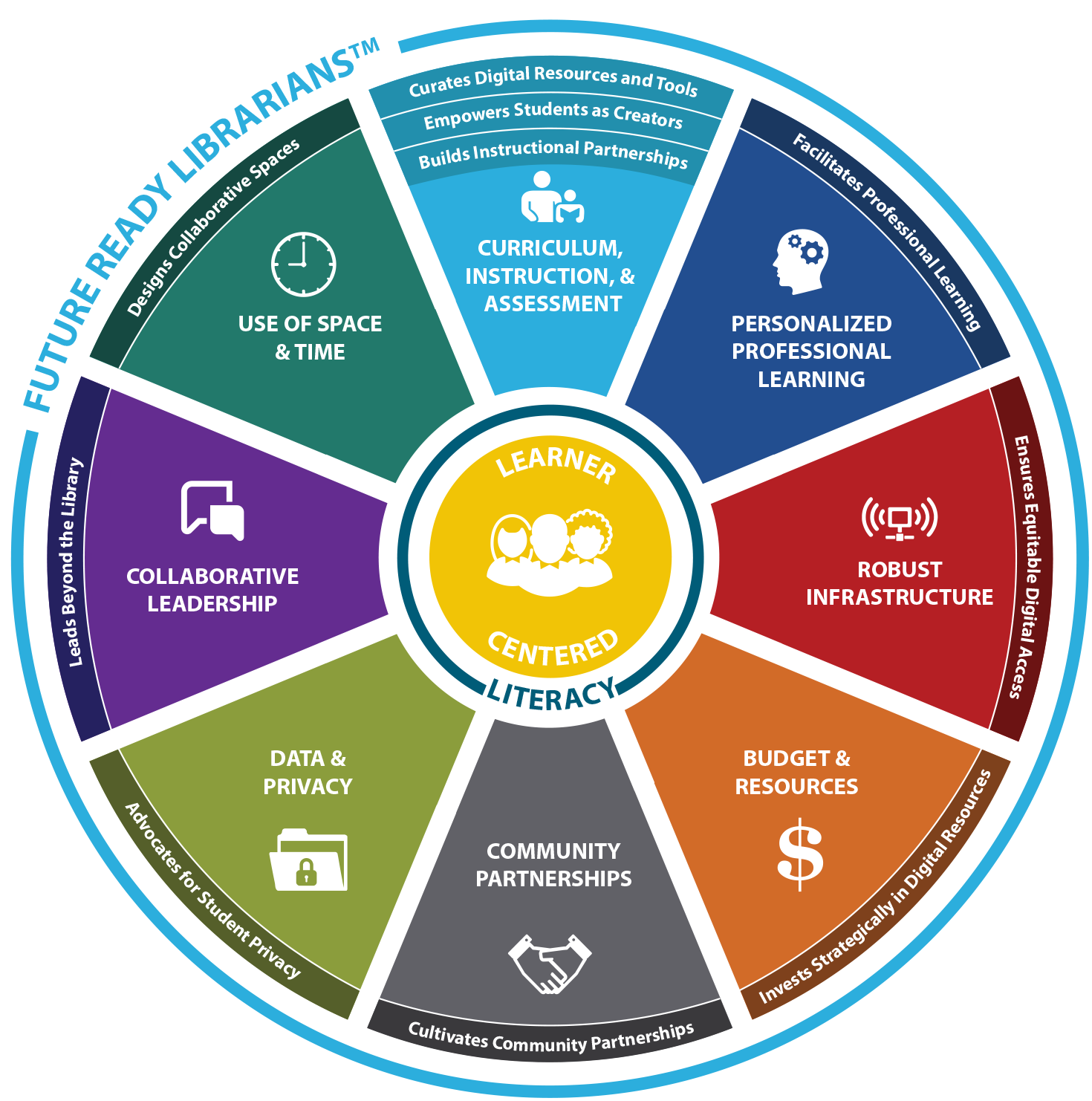
This has always been important to me as a teacher; I
enjoy having a voice at the table and being involved in decision-making or
supporting the schools’ plans and goals (or just organizing goofy dress-up days
with the student council kids!) In his
section about “The Roles and Mission of the Librarian”, Johnson discusses the concept of the
“crowsnester” and how they “look at and adapt to events on the horizon” (The Indispensable Librarian: Surviving and Thriving in
School Libraries in the Information Age, p 2-3) I love this description, and I’m fortunate to work
at a school that fosters collaboration - we have collab meeting times built
into our timetable, so we’re able to develop crosscurricular/interdisciplinary
lessons and units, and we’re expected to continue to forge ahead into new
curricular directions. My previous roles as department head and IB coordinator
have made me comfortable with spearheading staff initiatives; participation and
leadership in committee work is my wheelhouse. I find enjoyment and fulfillment
in being part of a school community and I think this is a big part of what lead
me to become a teacher in the first place.
A major part of
teacher-librarianship in our district involves leadership in aspects of
educational technology. I really like how, in this TedTalk, "Empowering the Teacher Technophobe" (https://www.youtube.com/watch?v=puiNcIFJTCU ) speaker Kristen Daniels discusses the difficulty we have as
educators in moving from the exposure phase (attending a workshop on a new
resource) to the implementation phase (actually freakin’ using the resource in
our classroom!) I think many of us can relate to this – we leave a staff
meeting or pro-d all jazzed up about something new, but then we can never find
the time to practice using it… and without practicing it on our own, we don’t
want to deploy it as a major part of a lesson – what if it doesn’t work? What
if I eff it up with all my students watching?!? Daniels points out how the
transfer of information isn’t enough to ensure people utilise it – educators
need actual support in the implementation process instead of an
information-based presentation, and workshops should be altered to reflect
this.
You can watch her TedTalk here:
3. Student participation (AKA “Think of the children”):

Another aspect of SLLC teamwork that I think is mutually beneficial is
‘employing’ library volunteers. I would like to start a student SLLC volunteer
program, as well as a parent one (Fun fact: my daughter is
currently in grade one, so thanks to the pandemic I’ve barely been inside her
school, let alone had the opportunity to volunteer, which is too bad, because
obviously I would be very bossy helpful.)
This
is a great opportunity to have students earn service hours (an excellent
initiative in our school district, and most other districts too, I imagine)
while helping out with tasks such as shelving, tidying the makerspace, simple
inventory, rearranging seating at end of day or setting up furniture for any
meetings or events that are taking place in the SLLC space. In my opinion,
having volunteers that come in at lunch not only helps out the TL; it can also
give students a sense of ownership in their school and their SLLC. In some
cases, it allows for a safe space and can be a relief from any social
struggles, overwhelmingly noisy environments during lunch break, or even
incidents of bullying for certain students. They can come to the library at
lunch to volunteer their time, but also as a means of escaping from what might
otherwise be a very discomforting or unhappy time in their school day (I think
we all know those kids who would much prefer to spend their recess discussing
the merits of the movie Dune versus
the book Dune with an adult, rather
than playing red rover or soccer.)
Student
volunteers may not only donate their time, but also their expertise. Ramsey’s
article, The School Tech Squad: A
Learning Commons Technology Boost, talks about their school’s ‘tech squad’ and
demonstrates how symbiotic a relationship between teacher and student can be
when the roles are reversed and the student becomes the expert. Ramsey
concluded, “that every school and teacher-librarian engage students in a
technology squad. And, it is not necessary to be an expert in technology to
have such a group. Just adopt the idea, I teach you...you teach me... and we
all learn together.’ It is all about collaborative expertise.” (The School Tech Squad: A Learning Commons
Technology Boost, p 31). Helping
with tech or volunteering in the makerspace could be a great occasion for
students who might not normally get to shine in academic areas, but perhaps are
excellent with tools, computers, and fostering creativity in younger students.

In my experience, I have always truly enjoyed working with students in a volunteer capacity and I feel like it not only fosters a strong rapport; it also allows them to learn the value of philanthropy and engagement in a leadership role; a lesson that lasts a lifetime.
Many of my former students have returned to visit and mentioned how much they gained from being part of the student council, the Free the Children/WE Schools group or the GSA and how thankful they were that I was their teacher sponsor.
(I have yet to experience a student pop by and say how joyfully they recall my lesson on MLA formatting, hmmm.)
WORKS CITED:
International Federation of Library Associations and Institutions. (2015). IFLA School Library Guidelines. 2nd revised edition.
Johnson, Doug. (2013). The Indispensable Librarian: Surviving and Thriving in School Libraries in the Information Age. 2nd edition. Santa Barbara, CA: Linworth.
Newfoundland Labrador
Education and Early Childhood Development. (2018). Extending
the Classroom: The Library Learning Commons.
Ramsey, K. (2010). The School Tech Squad: A Learning Commons Technology Boost. Teacher Librarian, 38(1), 28–31.
TedTalks (2013, November 06). Empowering the teacher technophobe: Kristin
Daniels @ TEDxBurnsvilleED. https://www.youtube.com/watch?v=puiNcIFJTCU
OTHER REFERENCES
Canadian School Libraries. (2020). Leading the Way with the Library Learning Commons.
https://www.canadianschoollibraries.ca/leading-the-way/
Husid, W.
(2013). Collaboration:
Make It Happen in Your School. Library Media Connection, 31 (4), 42–44.
Miller, S., &
Bass, W. (2019). Leading from the Library: Help your School Community Thrive
in the Digital Age. International Society for Technology in Education.


Hi again, Kat!
ReplyDeleteI enjoyed reading about your strategies and your emphasis on community. I agree that sharing or selecting information/experience/knowledge without considering feedback and input from the community you're working with is no good. Although I'm not a teacher or working at a school, I found the TED talk you shared on "technophobes" really relatable. I've worked in tech, education, hospitality, etc. and I've come across colleagues (and admittedly been there myself at times - most recently moving from Google to Microsoft Teams) who are really reluctant to implement new technology or tools because of lack of confidence, being comfortable with the old/tried/true ways... Getting comfortable with these tools and practising, as you mentioned, is KEY! I agree that all new tool tutorials/professional development workshops should include a ton of time for new users to actually play around with the tech, and have an expert on hand to address questions or troubleshoot on the spot. I learn by doing, and so do many others!
Thanks Megan! Our district started using Microsoft Teams a while back, and I really like it - but yes, it takes practice and consistent usage for sure.
DeleteAn excellent post filled with strong ideas and resources. Your work is reflective, well-developed, and comprehensive. The synthesis from your research provides strong takeaways for your reader.
ReplyDeleteI enjoyed reading about your strategies and goals. The video you included is powerful and a good reminder that we, like our students, need more than just information, we also need support and to do rather than just listening. I agree, having student volunteers in the library is a great way to build relationships and good way to empower students.
ReplyDeleteThis comment has been removed by the author.
ReplyDeleteSo many good ideas shared in this post Kat! I found the tech video you shared very relatable. It's a push we have in our school to provide the time at PD days for teachers to not just learn about, but also explore/play/learn, new technology. Ironically, the last time we did such a thing was a PD on Microsoft Teams, which occurred the same day the province announced schools were closing for two weeks back in 2020! The morning PD and scheduled time to learn came in very handy, very quickly! ~Shannon P.
Delete